
Broccoli & Salmon Rye Tartlets
Plus, how to line a tartlet case, and the impact of different flours on pastry.

Hello there and welcome back to Bake Experiments - a fortnightly newsletter on a mission to make high end baking easier, and healthier, for the home baker. With a smattering of food history, folklore and kitchen stories too.
I am so thrilled to have you here. And if you like what you read, please do press that heart, share, or subscribe. Thank you.
What's your favourite vegetable? Mine is broccoli. So, it made sense to me that for my first savoury bake on this stack, my beloved broccoli was included.
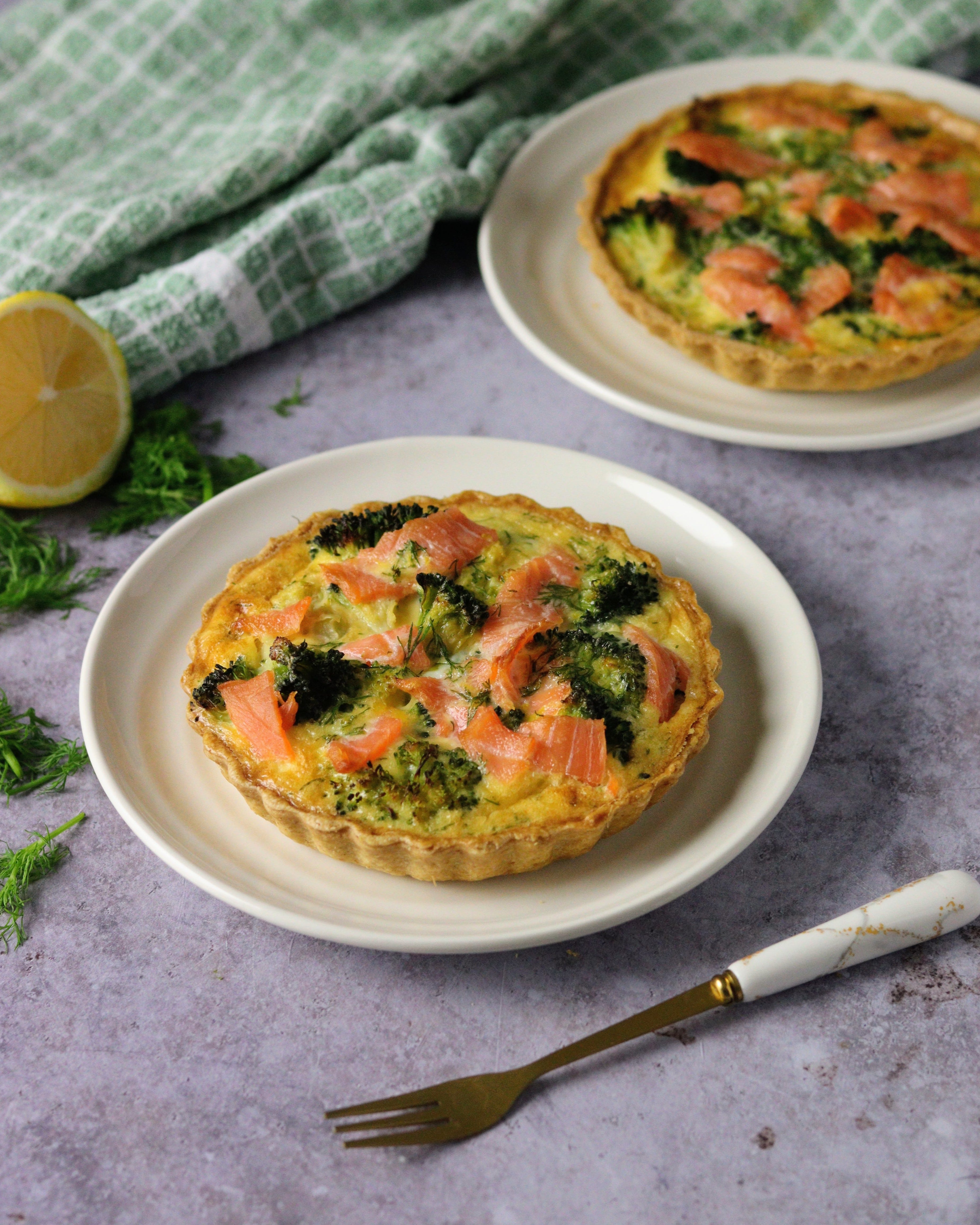
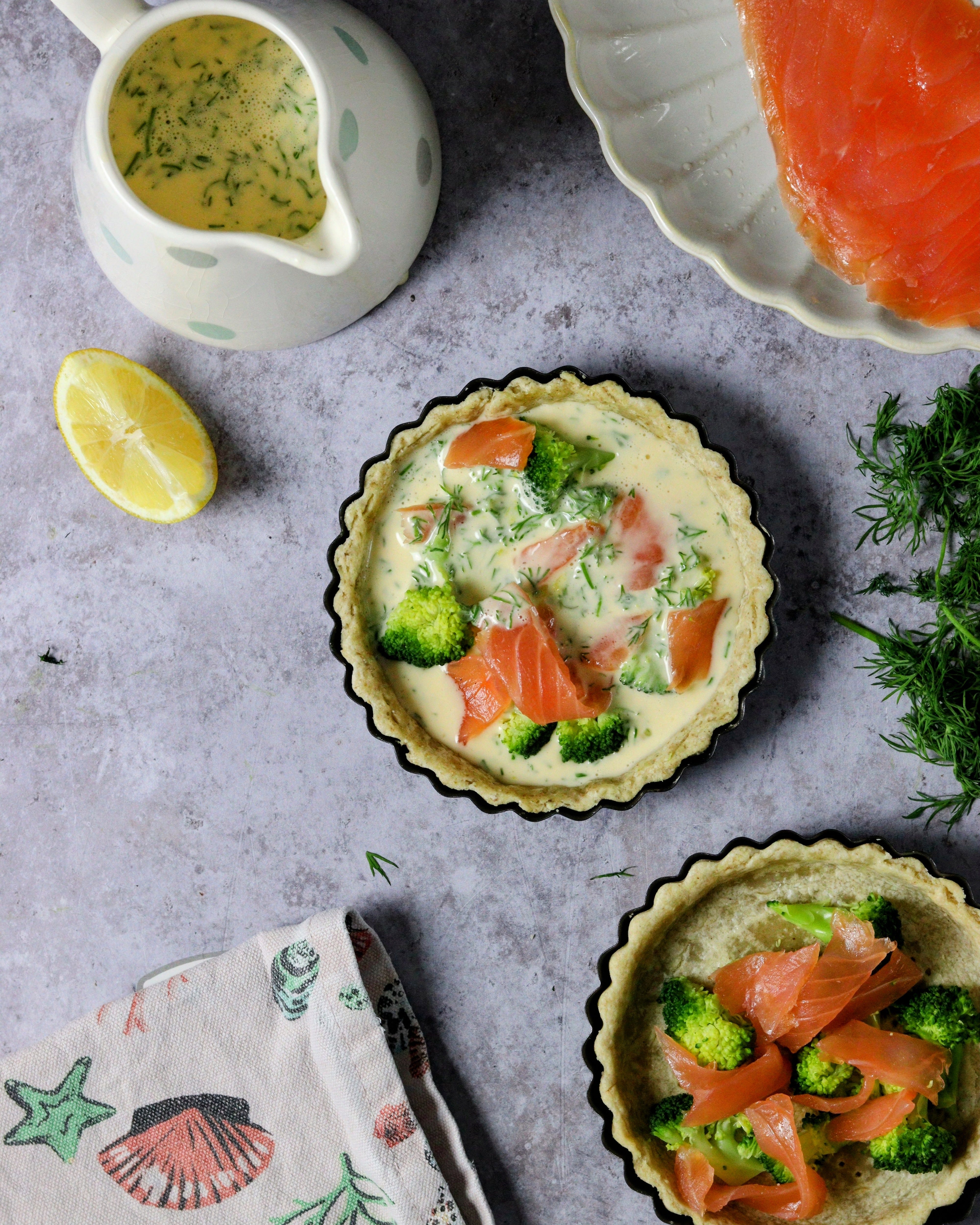
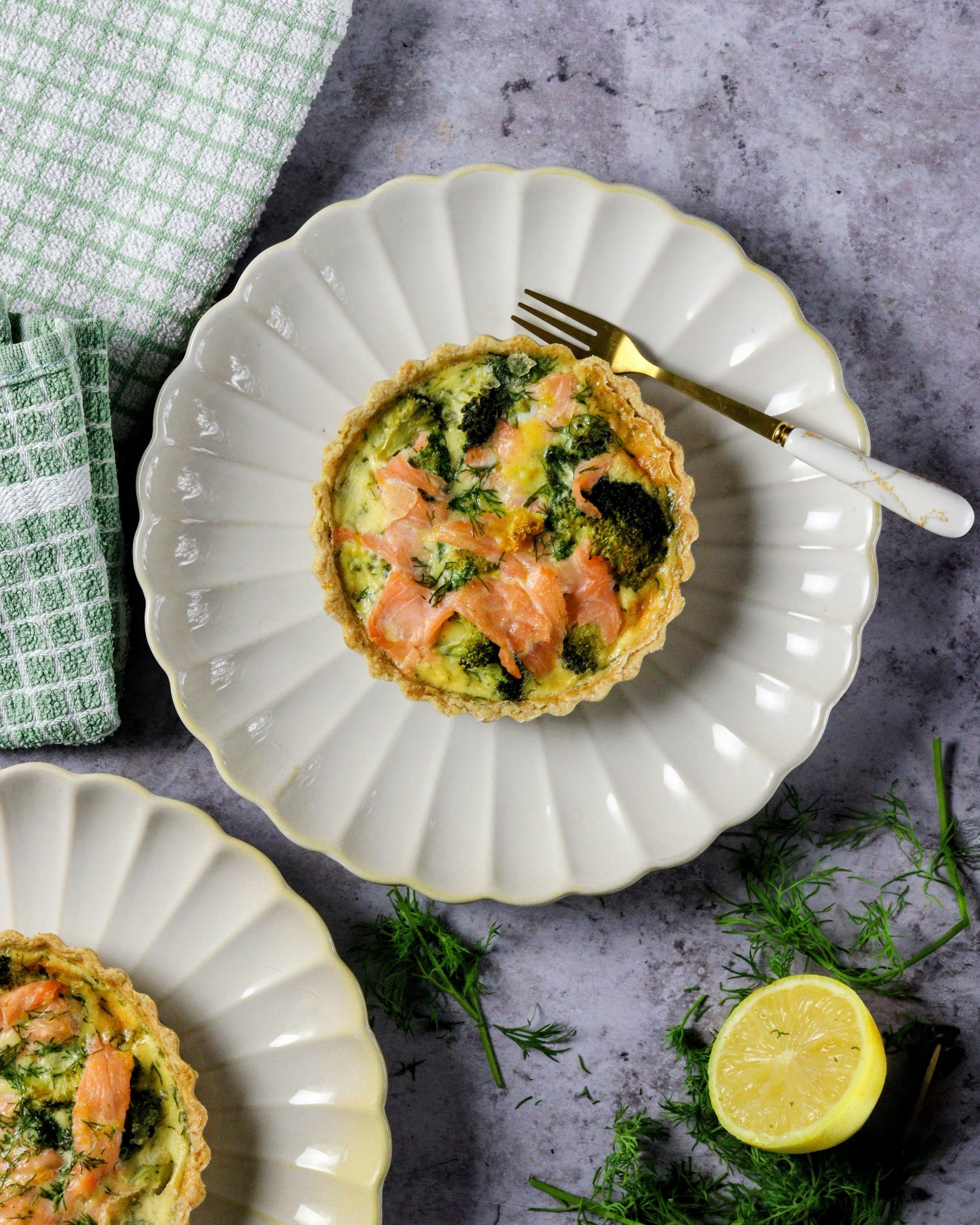
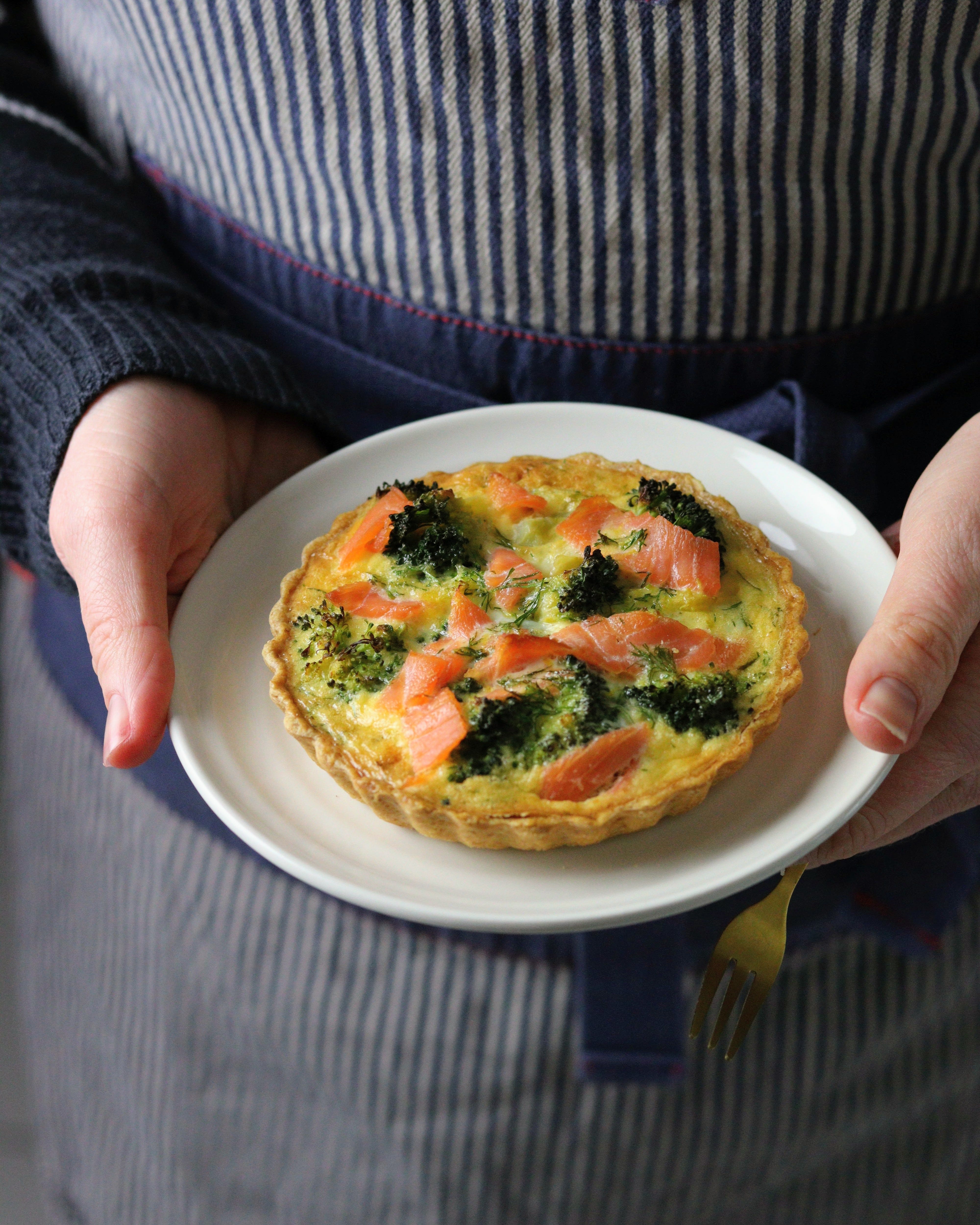
This tartlet is absolutely stuffed to the brim with the happy little trees. Paired with classic flavours such as salmon, dill and lemon, these dainty tartlets will truly elevate your brunch table. And so long as you follow a few key techniques, they are quite straight forward to make.
History, Health & Folklore
When broccoli was first introduced to England in the mid-18th century, it was referred to as “Italian Asparagus.”1
And Sicilian Josephine Vraca tells me that in some parts of Sicily, they have been referred to as “sparicini” or “little asparagus.” Which is just cuteness.
From a folklore perspective, broccoli is said to represent prosperity (green, innit), and this makes sense from a health perspective too. It's high in vitamin C, good for immunity, and vitamin K for strong bones. It's also been a long term joke between my husband and I about the impact it has on libido… Making broccoli suddenly more fun to be around.
“I’m always on the look out for new experiments. I’m not rushing to get to a specific destination. I’m playing a different game: a game of noticing, questioning and adapting.” Anne-Laure Le Cunff, Tiny Experiments.
The Experiment
For some time now, I have been keen to investigate the impact of different flours on pastry.
Buckwheat and rye both work with broccoli in terms of flavour, so, how would my usual pastry recipe work if I adapted it to include those flours?
Following the rye pastry ratio (50g rye flour to 200g plain flour) from Good Food’s Barney Desmazery, in his fabulous Kitchen Maths post, I tried this with both rye and buckwheat flour.
Buckwheat is not a flour I often see used in pastry, more in brownies and cookies, so I was very intrigued to see how this would pan out…
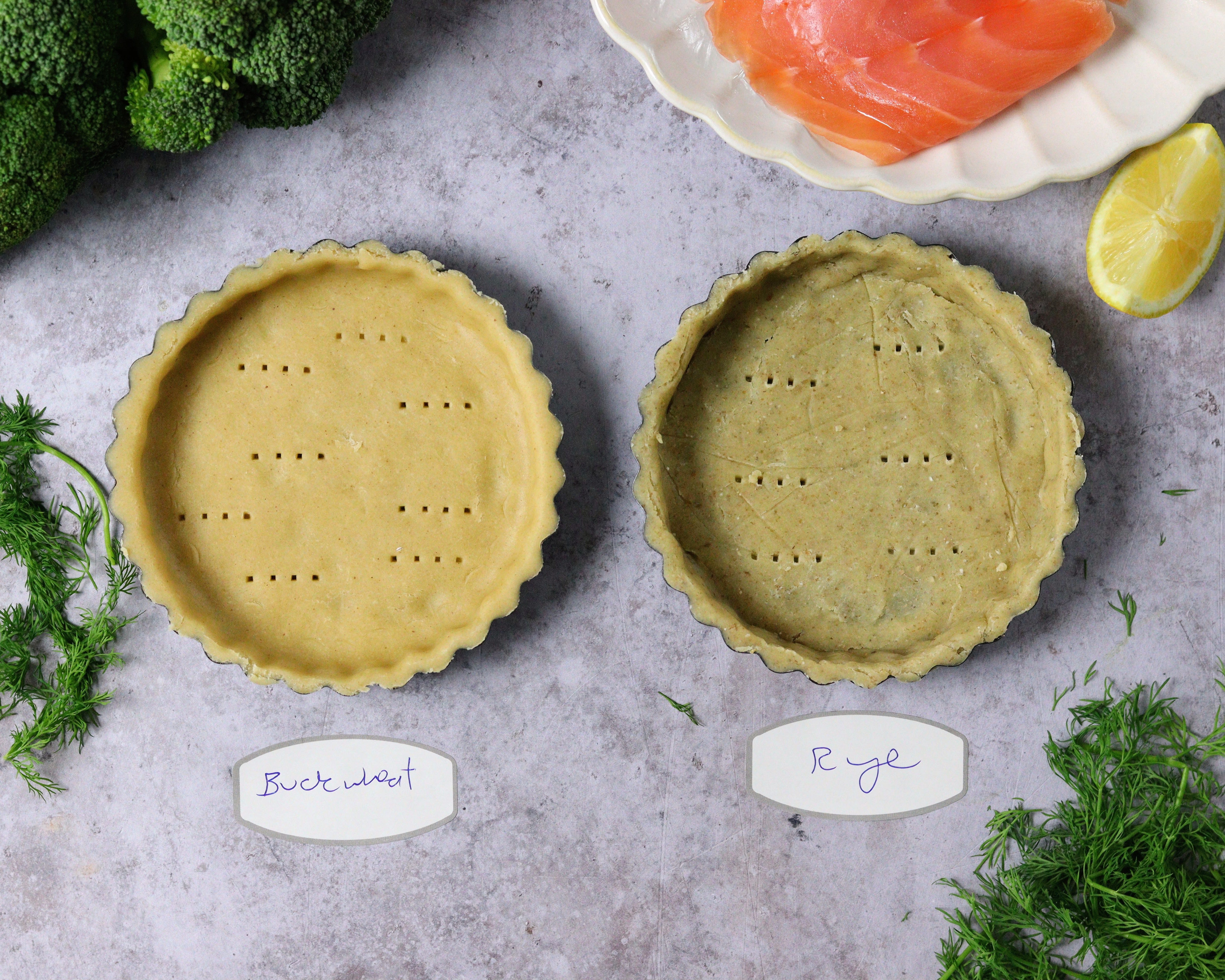
Rye:
Flavour wise, this was absolutely the winner for me, packing a more savoury punch than the buckwheat, and contrasting well with the broccoli and smoked salmon.
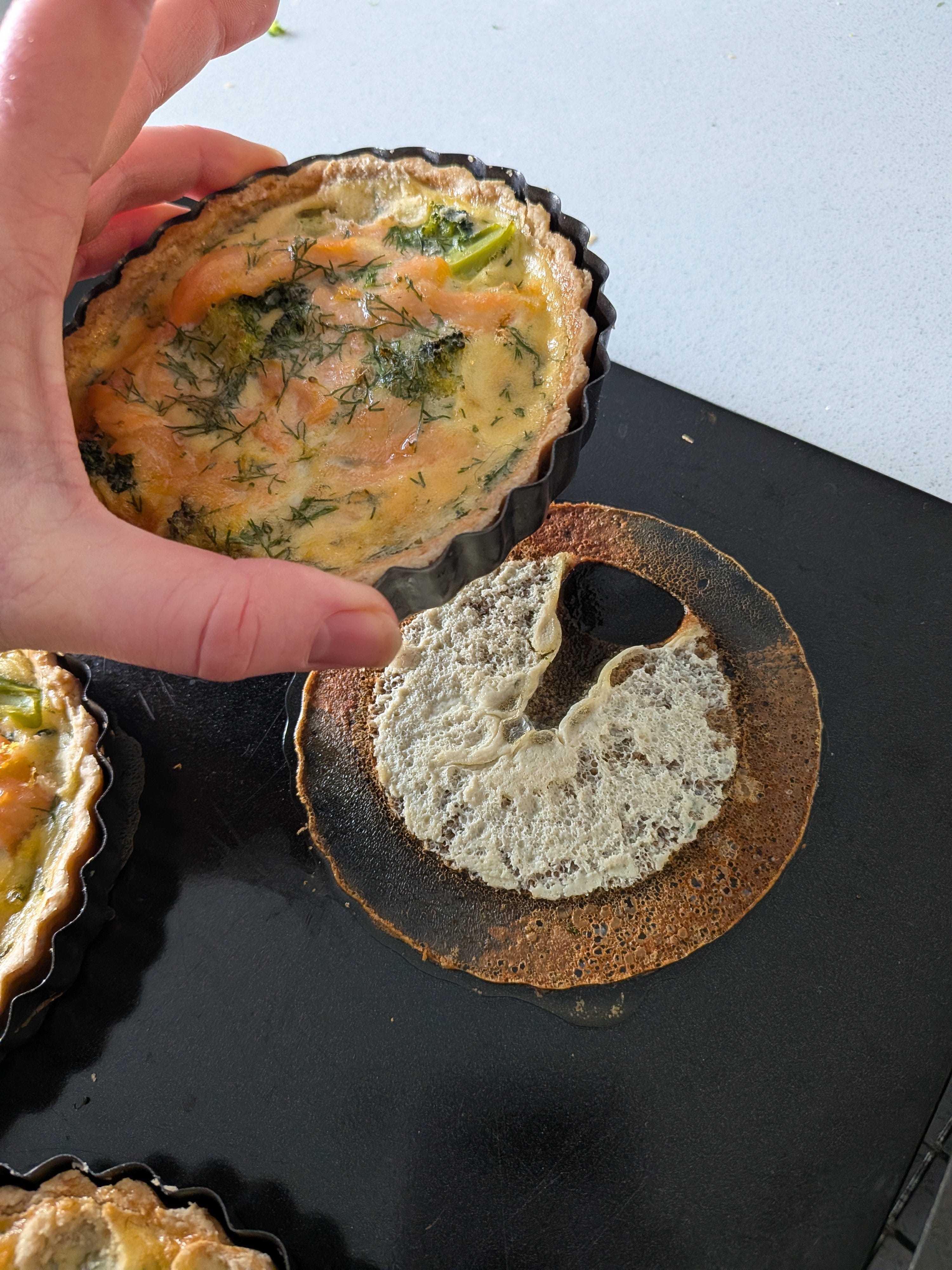
In terms of ease to work with, this was very, very crumbly. The pastry cracked and fell apart. Despite rebuilding and filling up these cracks to the best of my ability, filling still leaked everywhere (nightmare). Adapting the recipe to include much more liquid - double to what I would usually use - thankfully sorted this out.
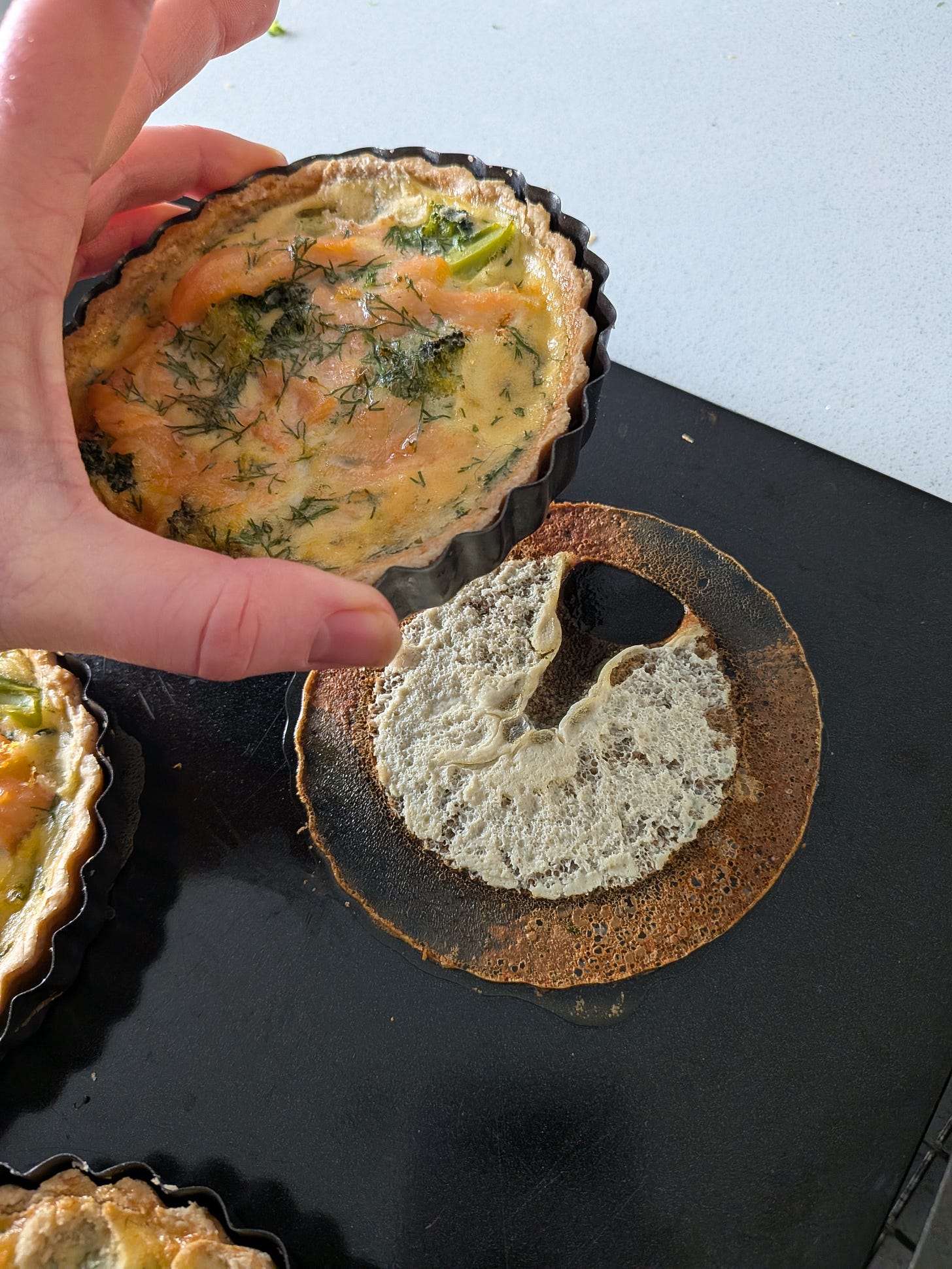
Noooooo! Leakage! There is a reason rye is so thirsty. According to Cotswold Flour, rye contains a group of complex sugars called “pentosans”, and these guys love a drink, stealing water from the proteins that make gluten.
Buckwheat
While this light pastry was fairly easy to work with, I unfortunately found the flavour a bit insipid. It was quite sweet, so may work better in a chocolate buckwheat tart. But for this recipe? No bang.
This pastry also needed more liquid than my usual pastry, and didn’t even start binding until I added a second egg yolk.
While all my content is free for three months, if you would like to become a paid subscriber, then thank you! I am most grateful.
You will receive full access to my recipe archive. And everything I personally earn on Substack, I donate to the World Central Kitchen.
The Recipe: Broccoli & Salmon Rye Tartlets
In this recipe, I’ve included a mini video guide on lining your tartlet case. If you are a pastry aficionado, you can easily skip it.
If you have health in mind, you can replace the cream with whole milk for a lighter version. The cream does give more oomph to the flavour and texture though.
Level: Intermediate
Time: Approx. 2.5-3 hrs, including resting time
Serves: Makes six tartlets
Specialist Equipment Needed: 6x 12cm fluted tartlet cases, stand mixer useful but not essential, dough scraper, pastry brush
Ingredients:
For the flour:
190g plain flour
40g wholemeal rye flour
125g unsalted butter, fridge cold
1 tsp fine salt
2x large egg yolks, fridge cold
3x tbsp milk, fridge cold
An extra egg, whisked, for egg washing
For the filling:
200g broccoli, cut into small florets
100g smoked salmon (I like Applewood smoked, for a milder taste)
6 large eggs
100ml double cream
2 tbsp fresh dill, finely chopped
Zest of a medium lemon
Method
Start with your pastry
I use a mixer to make my pastry, for two reasons; first, the more you keep those hot hands away from your pastry, the better. Second, I am lazy. However, with a batch as small as this, you can easily make it without a mixer.
Place your flour, rye flour and salt into your mixer and, with a paddle attachment, combine on a low setting.
Cut your cold butter into small cubes and combine again on a low setting. Once the mixture looks like sandy breadcrumbs, it is ready. If you don’t have a mixer, rub the butter in with your fingers.
Add your egg yolks and milk.
Mix until the mixture becomes like a smooth dough. This won’t take long, a minute or two at most.
If you don’t have a mixer, do this with a wooden spoon and then bring the dough together with your hands.
Bring the dough together and place on some cling film. As advised by the pastry master that is Julie Jones, I avoid rolling my pastry into a ball, and roll it out to about 5mm thick. The idea behind this is you won’t have to roll it as much when it is rested. Wrap in film. I have found this shortcrust is easier to work with if rested in a cool spot in your kitchen, rather than the fridge.
Rest for an hour.
Using a pastry brush, butter your tartlet cases.
If your pastry has been in the fridge, get it out and let it come to room temperature. Using a dough scraper, cut it into six equal sized pieces. You can roll your pastry on a floured work surface. But my preferred method is to roll between two sheets of baking paper, no extra flour needed.
Roll to approx. 2mm thickness, before turning out into your tartlet case.
Lining Your Tartlet Cases - a mini video guide
Here I have included a video guide on how to line these tartlet cases, with a couple of suggested techniques. I hope you find it useful.
Place your cases in the fridge for 30 minutes, to rest.
Once the tart cases are rested, you will need to blind bake them. Put your oven onto 180°C/160°C fan/356°F.
I do not use baking beads as they leave indents in your pastry, instead I use a combination of rice and lentils.
Using the baking paper you used to roll out your pastry (no need for wastage), cut them into six pieces and scrunch then up, before smoothing out again and using to line your tartlets. Make sure they are big enough to have excess around the edges of your tart. I can assure you, spilling rice mid bake, and then having to tweezer it out of your tart case is a right pain in the proverbial.
Fill with your rice and lentils and place your tart cases in the oven for 10 minutes.
Once your 10 minutes are up, pull them out of the oven and remove the baking paper full of rice and lentils. Your tarts may be a little raw at the base. This isn’t a problem, in fact, it’s the perfect time to check for any cracks, and fill them up with some leftover pastry, securing them with a bit of egg wash.
Place them back in the oven for five more minutes to bake out the rawness.
Now, get them out again to fully egg wash. This will give your pastry a gorgeous golden shine, and helps to seal the pastry, meaning no dreaded soggy bottoms!
This is also a good time to check for and fill up anymore cracks.
Get them back in the oven for 10 minutes. Until golden brown.
The filling
While you are blind baking, you can crack on with your filling.
Lightly steam your little broccoli florets for five minutes. Before placing on a piece of kitchen towel to drain slightly.
Cut your smoked salmon into small strips.
Whisk together your cream, eggs, dill and lemon zest and pour into a small jug. It’s really vital you use a small jug to slowly and delicately pour the mixture into all the nooks and crannies of your tartlets. For one test I used a large bowl, and spilled egg everywhere.
I don’t season this mixture, apart from a little grind of pepper, because the pastry and smoked salmon are quite salty already.
Once your tartlet cases are ready, gently place your broccoli florets into the base of the tart.
Place your salmon strips over the top, before pouring your mixture into the tartlets. You can zest a little more lemon on the top, for extra zing.
Place back in the oven and bake for 20-25 minutes. Ovens may vary, so make sure they are nicely set and the edges slightly golden. The broccoli might be beginning to very slightly char.
Best served warm, nom nom nom.
Lasts 3-4 days in the fridge, covered.
The stories we tell ourselves…
It's interesting the stories we tell ourselves. The narratives we have in our heads. For me, I have in my head that I am one of those ‘lockdown bakers’. And while it is true my baking ramped up a serious level in lockdown, I have baked for years upon years…
Twenty years ago, I made my ex-boyfriend and his friends a three course meal for his 21st birthday. Complete with chocolate layer cake at the end. All in a shabby, university accommodation kitchen. And before you ask, no, he didn't appreciate it enough. That's why he's an ex.
Another narrative I have in my head, is that I am shy. And while I am initially reserved, once I am comfortable I am full of stories. Someone I felt very comfortable sharing stories with was the charming Betty Williams on her Betty Eatz podcast.
I was honoured to be invited along. We chatted all sorts, from baking with kids to the power of herbs in desserts, and, crucially, how to spot a good recipe from an AI slop one. I do hope you enjoy.

Until next time… where we will be investigating the classic British biscuit, the Custard Cream.
Have you heard about the Bake Experiments Recipe Index? An easily searchable one stop shop for all Bake Experiments recipes and experiments.
According to the World Cancer Research Fund.
Interesting stuff. Will you be experimenting with any more flours?
I love the sound of this tart Shell, and I'm thinking they would be wonderful as even smaller tarts for appetiser bites (I'm obsessed with making small snacky things to eat--my favourite is a duck confit pie recipe I use to make minis 😊). We have small gathering for neighbours in a couple of weeks and I am going to try it and report back!
I wonder if you ever use a food processor for a quick dough? I make my pie dough this way, following a technique from Julia Child. It's very handy when you have a small amount and don't want to get out the stand mixer (or for those who don't have one). They key is to use the pulse function. So, for your recipe, pulsing the dry ingredients to blend, the butter to break it up (pulsing is brilliant here cause you have lots of control to get to the right consistency) and then "on" for the egg yolks and milk. Works a treat!